At Intersec Global 2027, ZASP is not bringing a product launch. It is bringing a question the Gulf has been asking us for years: what happens to a crash-rated barrier after the certificate — on the thousandth opening, in fifty-degree heat, with a service call due at 3 a.m.?
Intersec Global 2027 · 12–14 January 2027 · Dubai World Trade Centre · Booth S1-D32, Sheikh Saeed Hall 1
ZASP Editorial Team · November 2026 · approx. 6 min read

We have exhibited in Dubai before, and we return in January with a narrower brief than most of the hall. Intersec Global is the largest security gathering in the region — thousands of buyers, integrators and consultants moving through the Dubai World Trade Centre over three days. It would be easy to treat a show that size as a catalogue exercise. We would rather use it as an engineering clinic, because the questions the Gulf puts to a vehicle barrier are among the most demanding anywhere, and they are mostly questions a brochure cannot answer.
The region keeps building: mixed-use districts, gated communities, hotel arrival courts, logistics campuses and critical infrastructure. Almost all of it arrives with a vehicle perimeter attached. Consultants here increasingly specify to international crash ratings, as they should. But the specification is the beginning of the conversation, not the end of it. What follows is a set of practical questions about how a barrier behaves once it is in the ground and in service.
Three questions the Gulf keeps asking
In our experience, visitors to our stand tend to arrive at the same three questions in a different order each time. We have learned to answer all three before anyone asks.
Does it talk to the rest of the system?
A rising bollard or road blocker is rarely an isolated object. It has to answer to access control, CCTV, licence-plate recognition and the command-and-control room, and it has to do so in a way that the integrator can commission and the operator can audit. We build our control logic for that reality: dry-contact and bus signalling, event logging, remote status, and an interface that lets security staff reconfigure an entry point without calling a contractor. The question is not whether the barrier can be integrated. It is who owns the signal when something fails — and whether the failure shows up on a screen before it shows up in a queue of vehicles.
Will it still work in August?
Heat, dust and humidity are not footnotes in this market; they are the operating condition. A bollard at a mall entrance may cycle two thousand times a day, every day, for years, in ambient temperatures that would shorten the life of components specified for a mild climate. The engineering answer is unglamorous: duty ratings that assume continuous service, hydraulic systems chosen for thermal stability, seals and finishes selected for dust and coastal air, and a maintenance interval that a local team can actually keep. A crash rating tells you what a barrier does once. A duty cycle tells you what it does every day for a decade.
A crash rating tells you what happens once. A duty cycle tells you what happens every day for a decade.

Who answers the 3 a.m. call?
The third question is about people, not hardware. A barrier that stops a truck but waits three weeks for a spare part is a liability, not an asset. ZASP manufactures in its own production base in Hebei Province, with fifteen regional offices across China and a branch in Singapore; that structure exists so that a project in the region has a route to engineering support and spares measured in days rather than quarters. We would rather quote a total cost of ownership that includes the service call than win on a sticker price and lose the client in year two.
One threshold, two vocabularies
When a consultant writes a Gulf specification, the same performance benchmark keeps appearing under different names. It is worth being precise about what it means, because the difference between a compliant barrier and a decorative one is measured in less than a metre.
| THE K12 / P1 THRESHOLD AT A GLANCE | |
| VEHICLE | 6,800 kg (15,000 lb) medium-duty truck |
| SPEED | 80 km/h (50 mph) |
| PENETRATION | No more than one metre past the barrier line (P1) |
| MODERN NOTATION | ASTM F2656 M50/P1 — the same performance in current language |
| TYPICAL USE | Stadium, airport, hospitality and critical-infrastructure perimeters |
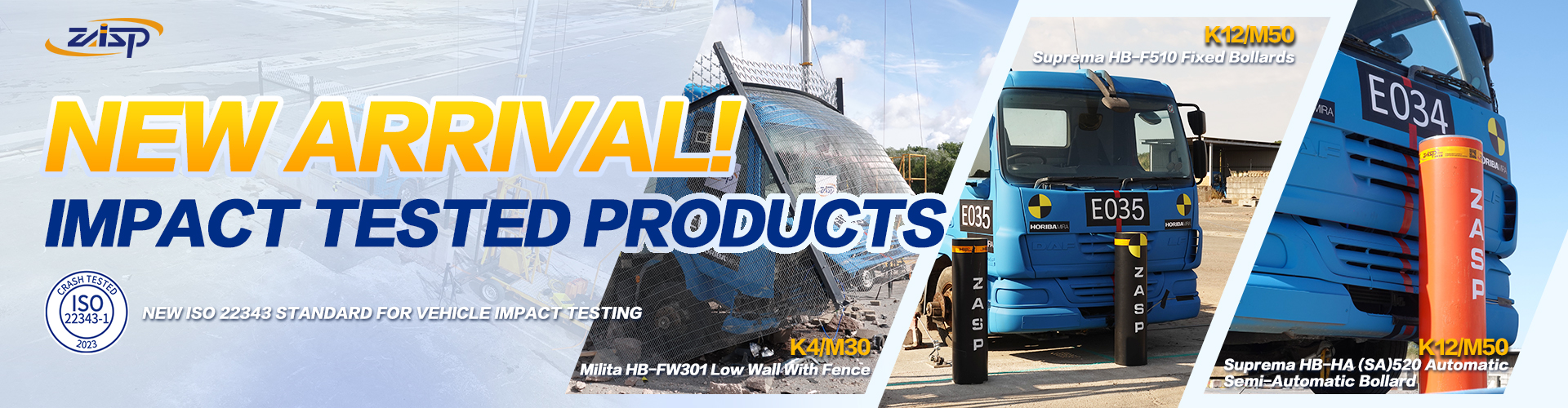
Penetration is the number that matters. A bollard that stops a car is not the same product as one that stops a truck, and a barrier that stops a truck but lets it travel three metres into a queue of people has not done its job. Alongside the K12 class, the K4 rating — a 7,500 kg vehicle at 48 km/h with zero penetration — suits lower-speed, pedestrian-adjacent approaches where the threat profile is different. ZASP’s crash-rated range is impact-tested to IWA 14-1, PAS 68 and ISO 22343-1, and we will show the reports, not just the ratings.
Beyond the headline rating
Not every approach can take a deep foundation. Existing slabs, services and tight urban geometry often rule out the civil works that a conventional barrier expects. That is why the shallow-mounted road blocker and the modular MVB501 matter in this region: the first is designed for entrance points where excavation is constrained, and the second is a portable, high-strength interception system tested against vehicles travelling at up to 80 km/h. For streetscape and retail environments, fixed, removable and custom street bollards carry the same protective intent in finishes and colours that an architect will accept.
The right barrier is the one that fits the drawing you already have — not the one that looks best in a datasheet.

What we are bringing to Booth S1-D32
We are not bringing a crash test to Dubai; those happen at certified proving grounds and the reports are public. We are bringing the hardware and the people: cutaway models of hydraulic rising bollards and road blockers, control-system demonstrations, finish samples, and engineers who would rather look at your site plan than hand you a leaflet. If you are specifying an entrance for a new development, a hotel, an event venue or a critical site, bring the drawing, the traffic study or the constraint that has been blocking the design. We will give you a feasibility opinion on the spot, and an honest one about where geometry says a barrier will not work.
And if you are an integrator, contractor or consultant building a practice around the region’s construction pipeline, come and talk about partnership. We are not coming to Intersec to ship a container of bollards and leave. The Gulf rewards suppliers who stay.
FAQ
Where and when is Intersec Global 2027?
12–14 January 2027 at the Dubai World Trade Centre, Dubai, United Arab Emirates. ZASP exhibits at Booth S1-D32 in Sheikh Saeed Hall 1.
What will ZASP exhibit in Dubai?
Hydraulic automatic rising bollards, fixed and removable crash-rated bollards, shallow-mounted road blockers, rising beam barriers, the modular MVB501 and custom street bollards, with control systems and architectural finish options.
What is the K12 / P1 crash rating?
K12 is the US Department of State vehicle-barrier rating for a 6,800 kg vehicle at 80 km/h with no more than one metre of penetration; under ASTM F2656 it is written M50/P1. It is the benchmark for high-consequence vehicle perimeters.
Can ZASP systems integrate with our access control and command centre?
Yes. The control systems support dry-contact and bus signalling, remote status and event logging, and are designed to sit alongside access-control, ANPR and command-and-control platforms. Bring your interface specification to the booth.
How do I book a meeting with ZASP at the show?
Visit Booth S1-D32 during show hours, or contact the ZASP team in advance through zaspbarriers.com.
| MEET US |
| Intersec Global 2027 |
| 12–14 January 2027 |
| Dubai World Trade Centre, Dubai, UAE |
| Booth S1-D32, Sheikh Saeed Hall 1 |
ABOUT ZASP
Beijing ZhuoAoShiPeng Technology Co., Ltd. (ZASP), founded in 2009, is a specialised manufacturer of hostile vehicle mitigation and vehicle access control equipment, including hydraulic automatic rising bollards, fixed bollards, road blockers and boom barriers. With a production base in Hebei Province, fifteen regional offices across China and a branch in Singapore, ZASP serves public authorities, critical infrastructure operators and security integrators worldwide. ZASP products are impact-tested to international standards including IWA 14-1, PAS 68 and ISO 22343-1 performance requirements, and are engineered for continuous duty in real operating conditions — from city-centre pedestrian zones to logistics hubs and high-security facilities.
ZASP · INTERSEC GLOBAL 2027 · BOOTH S1-D32 · INTO THE GULF
